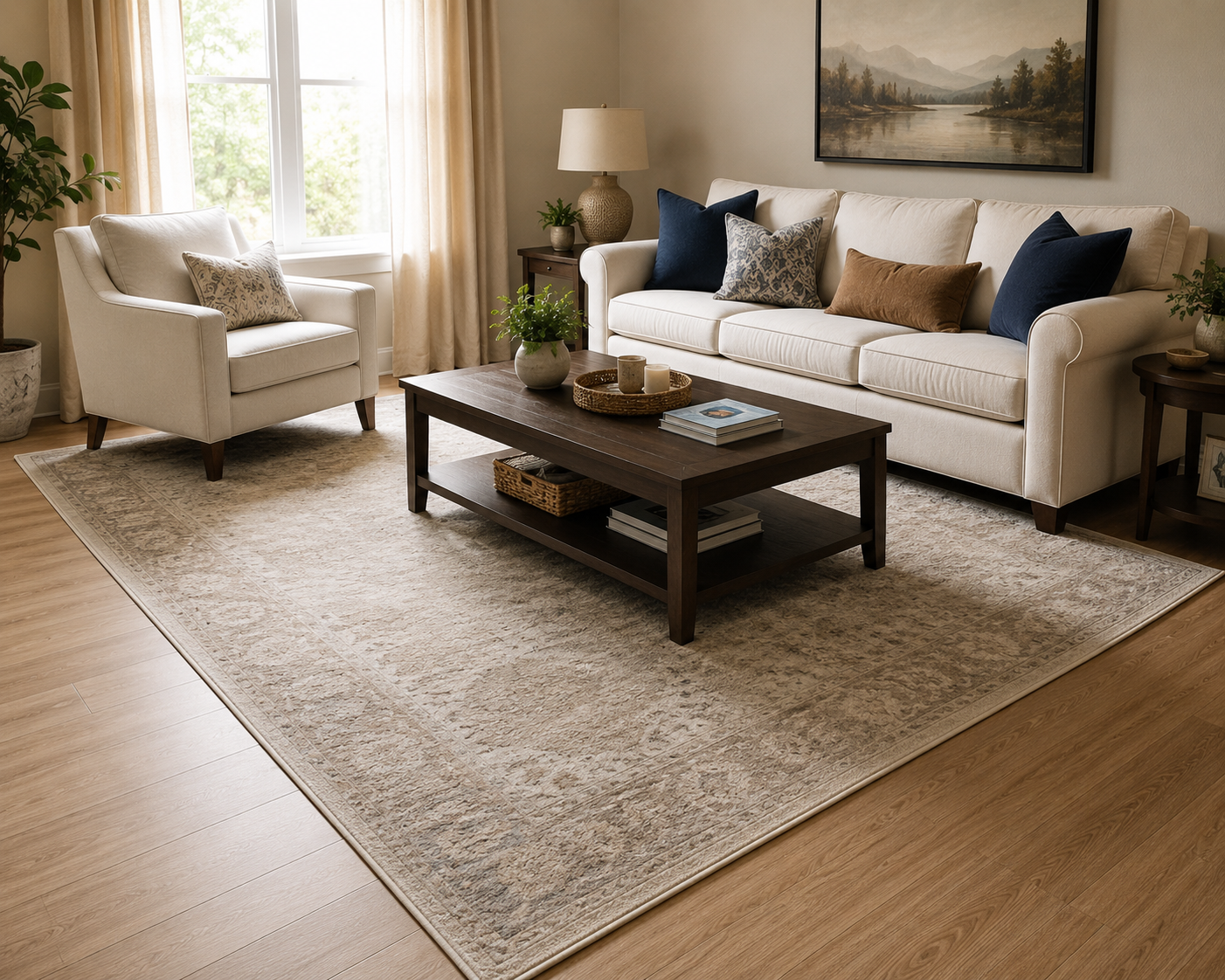
Rug Sizing: The One Guide You Actually Need
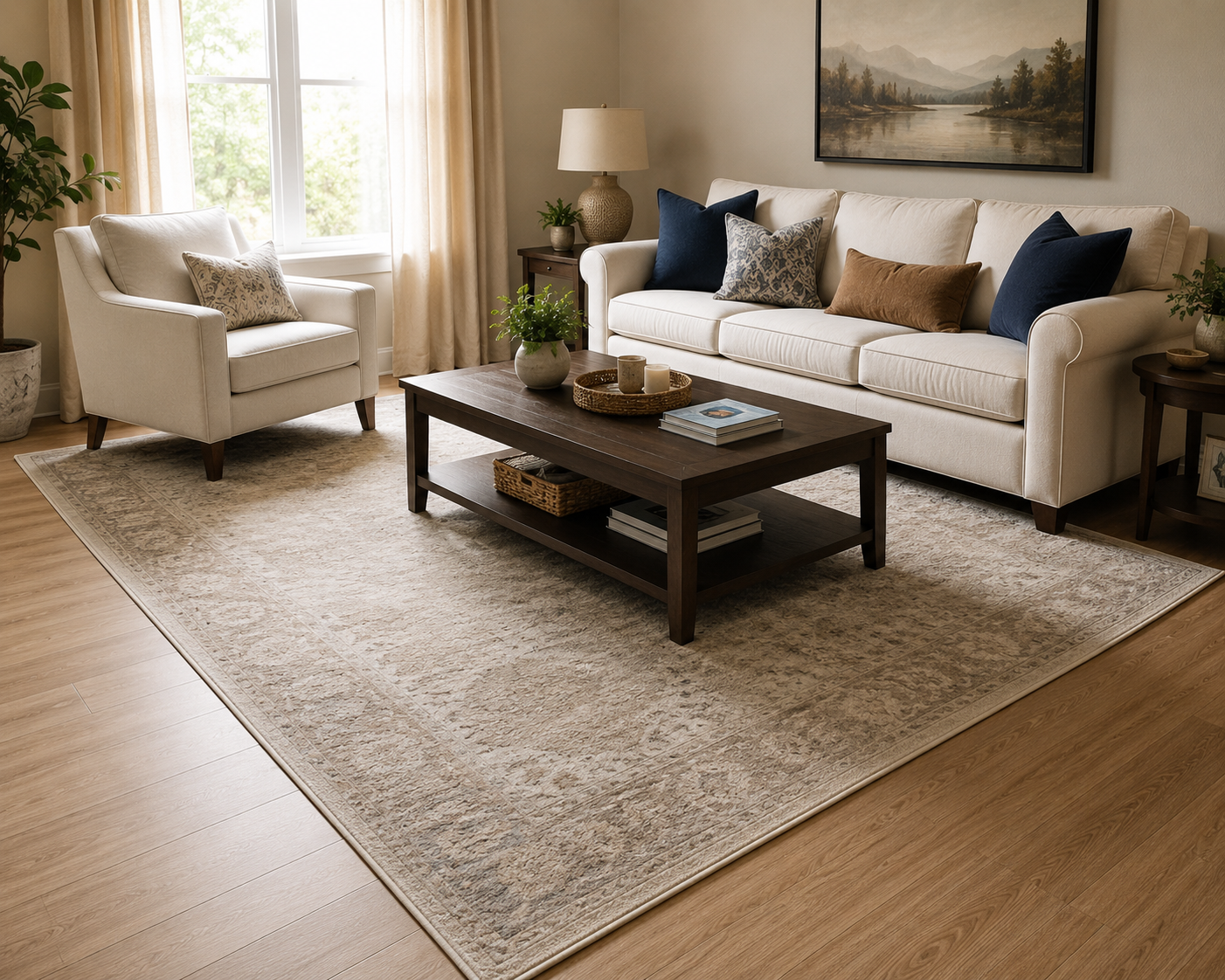
Disclosure: this post contains affiliate links. If you buy something through one, I may earn a small commission at no extra cost to you.
Almost every rug I've seen in someone's home is too small. Mine was too small for two years, in a room that needed something nearly twice the size, and I knew it and lived with it anyway because admitting it meant spending money.
There's a reason this happens so consistently, and it isn't taste. Rugs look enormous rolled up in a store and enormous again in the box. Then you unroll one in your actual room and it shrinks. Every single time.
So this is the sizing math for each room, plus the thing to do before you order anything.
The principle, before the numbers
A rug's job is to define a zone. It draws a boundary around a group of furniture and says these things belong together.
A rug that touches your furniture does that. A rug floating in the middle of the floor with nothing on it does the opposite it chops the room into pieces and makes the space read smaller, which is the exact reverse of what people are usually trying to achieve when they buy a small rug for a small room.
Bigger rug, bigger room. Counterintuitive, and it's the single most useful thing in this post.
Living rooms
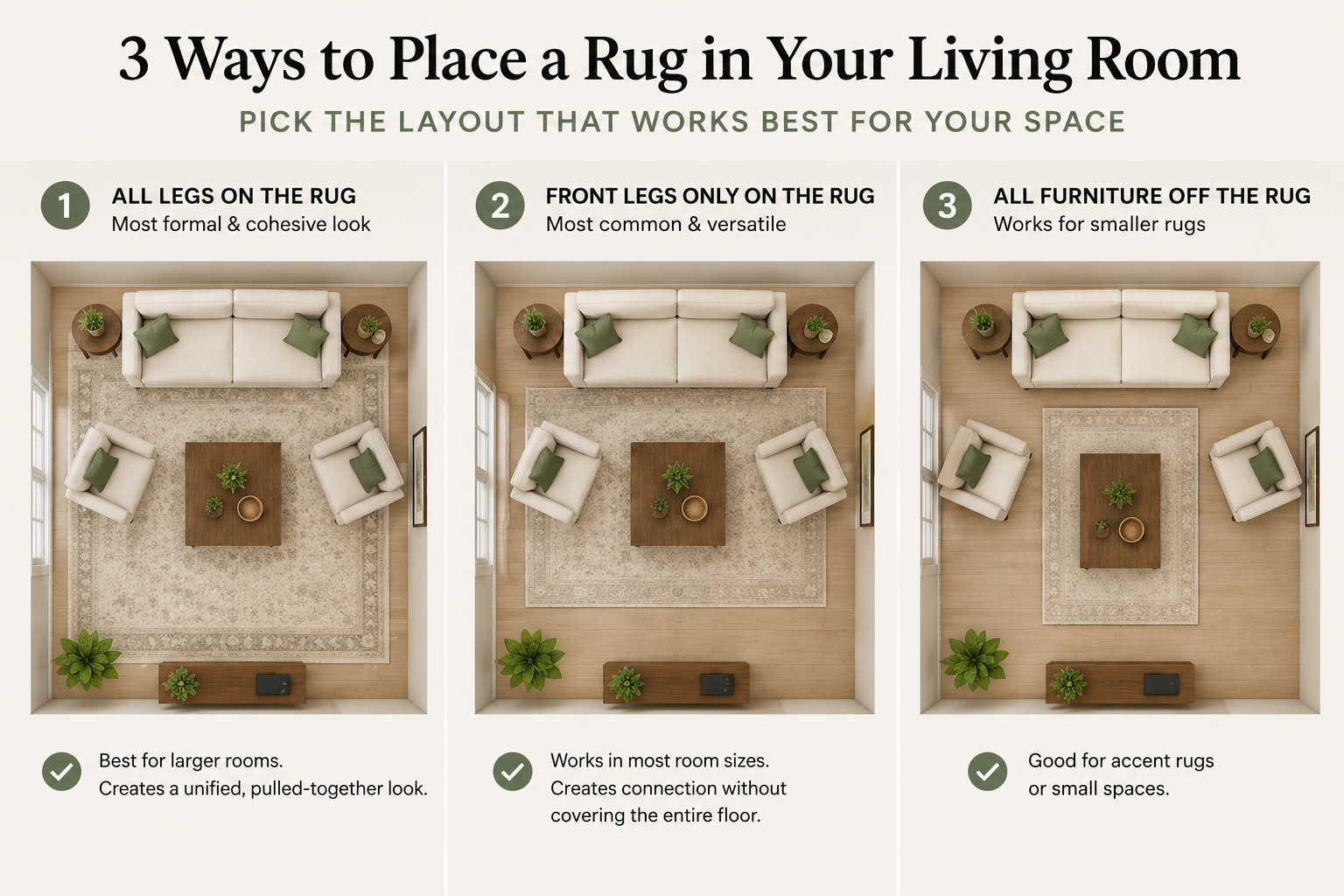
Three arrangements work. Pick based on budget and room size.
All legs on
Every piece of furniture sits entirely on the rug, with the rug extending a few inches beyond.
The most luxurious-looking option and the most expensive, since it needs a large rug. Best in big or open-plan rooms where the seating area needs a clear boundary.
Front legs on (the practical default)
The front legs of the sofa and chairs sit on the rug; the back legs sit on bare floor.
This is what most people should do. It ties the furniture together, costs less than all-legs-on, and it's forgiving of imperfect measurements. If you take one thing from this post, it's this arrangement.
All legs off
The rug sits entirely inside the seating area, with all furniture on bare floor around it.
Only works when the rug is still large enough to nearly reach the furniture within a few inches. Beyond that gap it becomes the floating-doormat problem.
The sizes
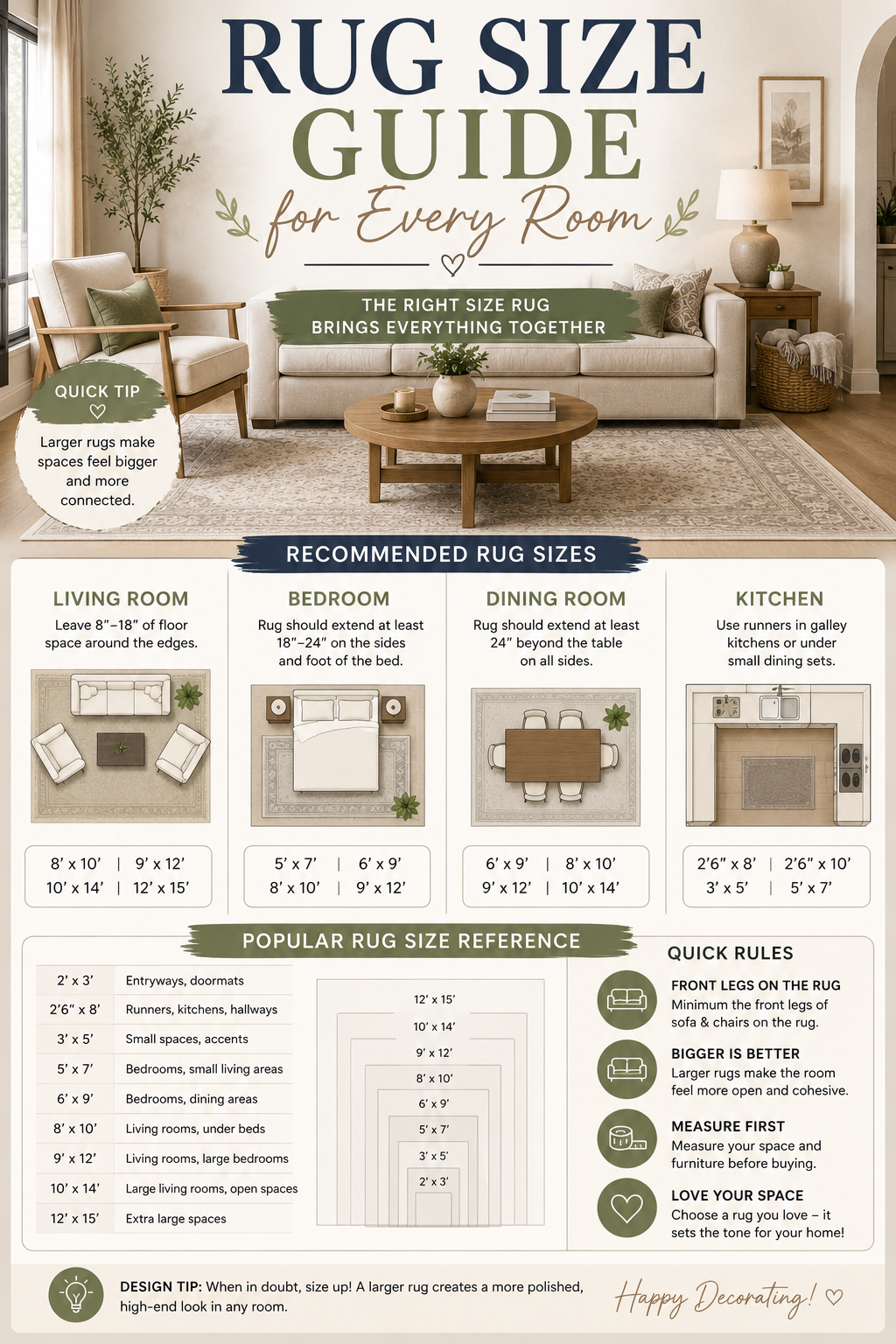
- Small living room (up to about 10 × 12 ft): 5 × 8, front legs on
- Average living room (12 × 15 ft): 8 × 10 the most common correct answer
- Large living room (15 × 20 ft and up): 9 × 12 or 10 × 14
- Open-plan: size to the seating group, not the room
Leave a border of floor. Aim for 12 to 18 inches of bare floor between the rug edge and the walls. Wall-to-wall coverage reads as carpet, not a rug, and it loses the framing effect entirely.
If you're between two sizes, go bigger. I have never once heard anyone say their rug was too large.
Bedrooms
Two approaches, both fine.
Under the bed (the standard)
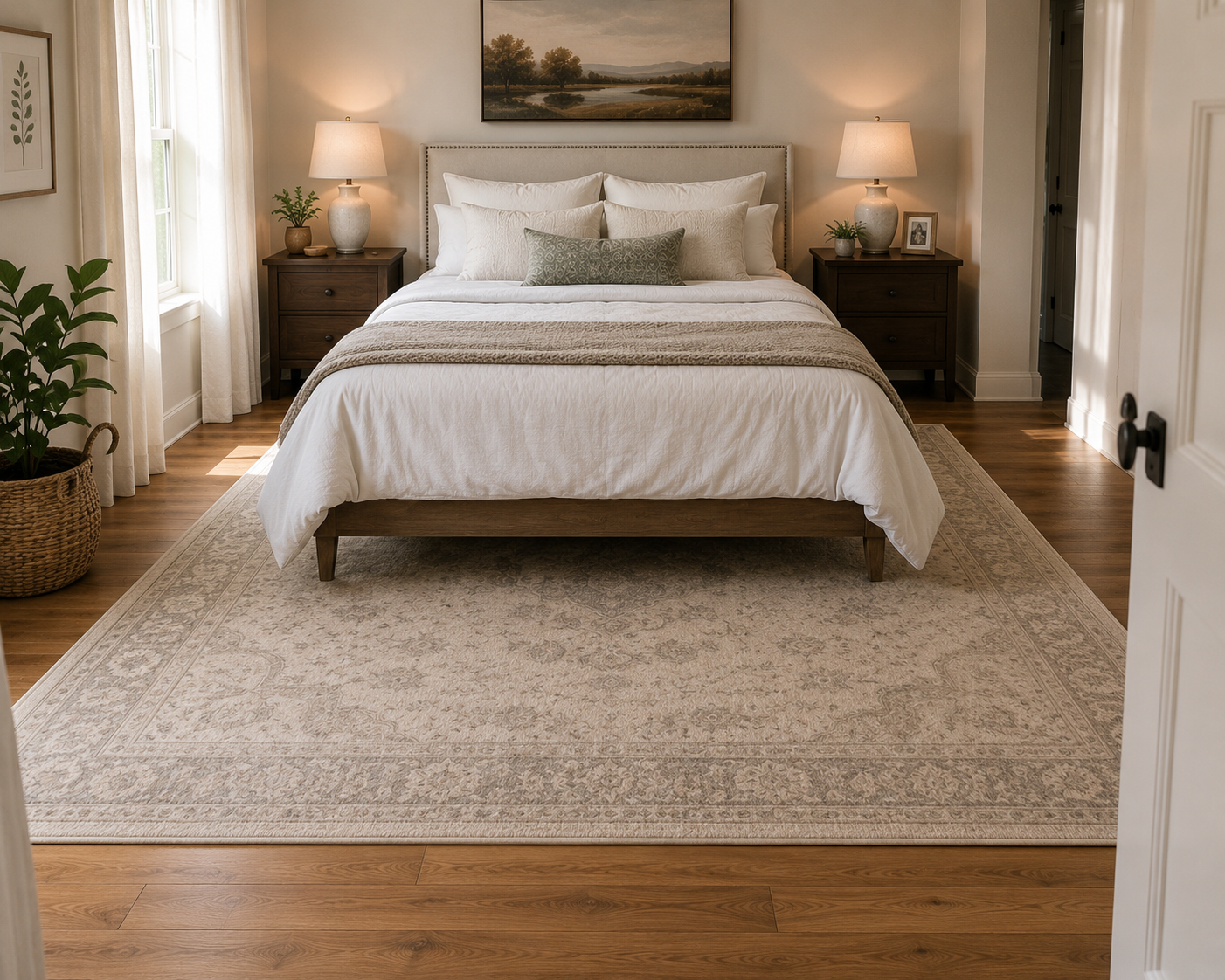
The rug extends beyond the bed on both sides and at the foot. It should be wide enough that your feet land on it getting out of bed which is the whole practical point.
- Queen bed: 8 × 10 minimum
- King bed: 9 × 12
- Full/double: 6 × 9 works, 8 × 10 is better
Placement: start the rug about two-thirds of the way down the bed, so it runs from just below the nightstands to well past the foot. Sliding the whole rug under including the headboard wastes a lot of expensive rug where nobody sees it.
Aim for 18 to 24 inches of rug showing on each side and at the foot.
Runners on each side
Two runners flanking the bed. Cheaper, works in small rooms, and it gives you the warm-feet benefit without a large rug.
Less visually unifying, and the runners slide around unless you use pads. Fine as a budget solution.
Dining rooms
This one has an actual rule, and it's the one people get wrong most often.
The rug must extend at least 24 inches past the table on every side — 30 inches is better.
That's not aesthetic. It's so a chair stays on the rug when someone pushes back to stand up. A chair with its back legs catching the rug edge tips, scratches the floor, and eventually damages the rug.
Measure your table, add 48 to 60 inches to both the length and the width, and that's your minimum rug.
- Table seating 4 (about 36 × 60): 8 × 10
- Table seating 6 (about 40 × 72): 9 × 12
- Table seating 8+: 10 × 14 or larger
Material matters more here. Dining rooms mean food. Low-pile, flat-weave, or washable anything with depth traps crumbs and stains. More on that in the material comparison → Wool vs. Jute vs. Synthetic Rugs.
Hallways and entryways
Runners: leave 4 to 5 inches of bare floor on each side, and stop about 6 inches short of the walls at each end. A runner that spans the full width looks like a carpet installation gone wrong.
Standard runner widths are 2 to 3 feet; lengths run from 6 to 14 feet.
Entryways: small and washable. This is the one place a small rug is correct it's marking a threshold, not defining a zone.
Kitchens
Runners in front of the sink or the main work area. Low pile or flat weave, and washable if you cook at all.
Skip large kitchen rugs. They get dirty faster than you'll want to deal with, and they interrupt the traffic patterns that kitchens depend on.
Layering, briefly
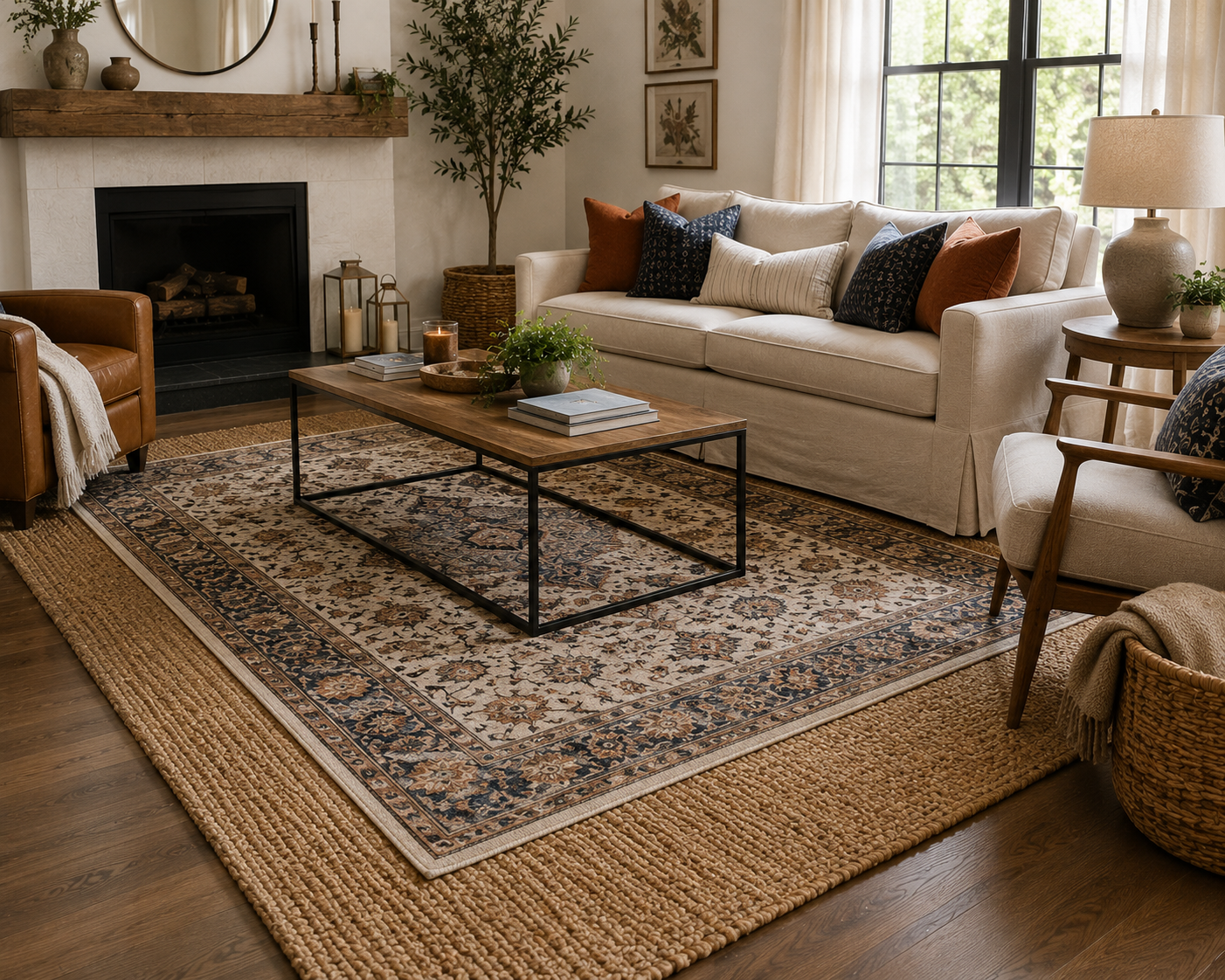
A small nice rug on top of a large plain one solves two problems: it gets you enough coverage without buying a large expensive rug, and it adds texture.
What works: a large natural jute rug as the base, with a smaller wool or patterned rug on top, angled or centered.
What to watch: the base rug still has to be big enough to do the sizing job. Layering isn't a way around the measurements — it's a way to afford them.
Before you order: the ten-minute check
Tape the outline on the floor. Painter's tape, the actual dimensions of the rug you're considering, on your actual floor.
Then live with it for a day. Walk your normal routes. Sit on the sofa and look at where the tape sits relative to the furniture legs. Look at it from the doorway.
This takes ten minutes and it is the reason I haven't bought a wrong rug since. It's the same habit that applies to sofas → The Sofa I Regret Buying and any furniture layout → How to Arrange a Living Room With One Usable Wall — measure into the actual space, not into your imagination.
Also measure the room itself, not the room you remember. Floors are rarely square, especially in older buildings, and a 12-foot room is often 11 feet 8 inches.
Rug pads: not optional
A felt and rubber rug pad does four things: stops the rug sliding, adds cushioning, protects the floor underneath, and extends the rug's life by absorbing foot pressure.
Budget about 10% of the rug's cost. Cut it 1 inch smaller than the rug on all sides so it doesn't peek out.
The cheap thin foam ones disintegrate within a couple of years and leave residue on hardwood. Felt-and-rubber is worth the difference.
The sizes, in one place
| Room | Setup | Size |
|---|---|---|
| Small living room | Front legs on | 5 × 8 |
| Average living room | Front legs on | 8 × 10 |
| Large living room | All legs on | 9 × 12 or 10 × 14 |
| Queen bedroom | Two-thirds under bed | 8 × 10 |
| King bedroom | Two-thirds under bed | 9 × 12 |
| Dining, seats 4 | Table + 24–30" all sides | 8 × 10 |
| Dining, seats 6 | Table + 24–30" all sides | 9 × 12 |
| Hallway | 4–5" floor each side | 2–3 ft runner |
The short version
Buy the bigger one. Front legs on the furniture, minimum. 24 inches past the dining table on every side. Tape it out before you order, and budget for a pad.
The rug is usually the largest single surface in a room after the walls, and getting it right does more for how a space reads than almost anything else you can buy which is why it's worth the ten minutes of tape, and why I regret every one of the two years I spent not doing it.
Affiliate Disclosure
Some links in this post are affiliate links. If you buy something through one, GlamNestStudio may earn a small commission it doesn't cost you anything extra. I only link to things I'd recommend to a friend, and I've used or genuinely researched everything mentioned here. It's what keeps the guides on this site free.
Before you go
More of the measurements that quietly decide how a room reads curtains, layout, proportions across the guides on GlamNestStudio.