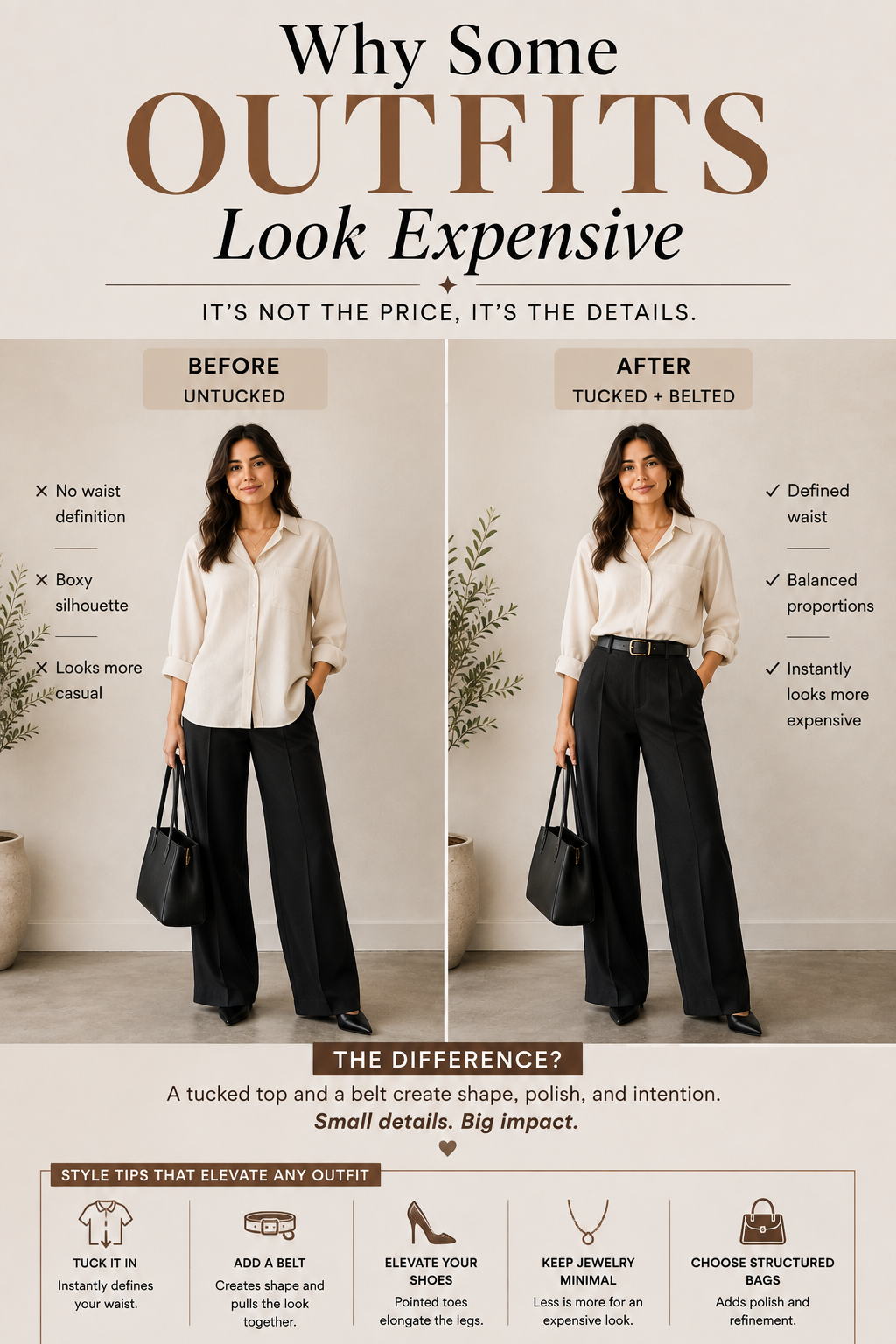
Proportion: The Reason Some Outfits Look Expensive
Disclosure: this post contains affiliate links. If you buy something through one, I may earn a small commission at no extra cost to you.
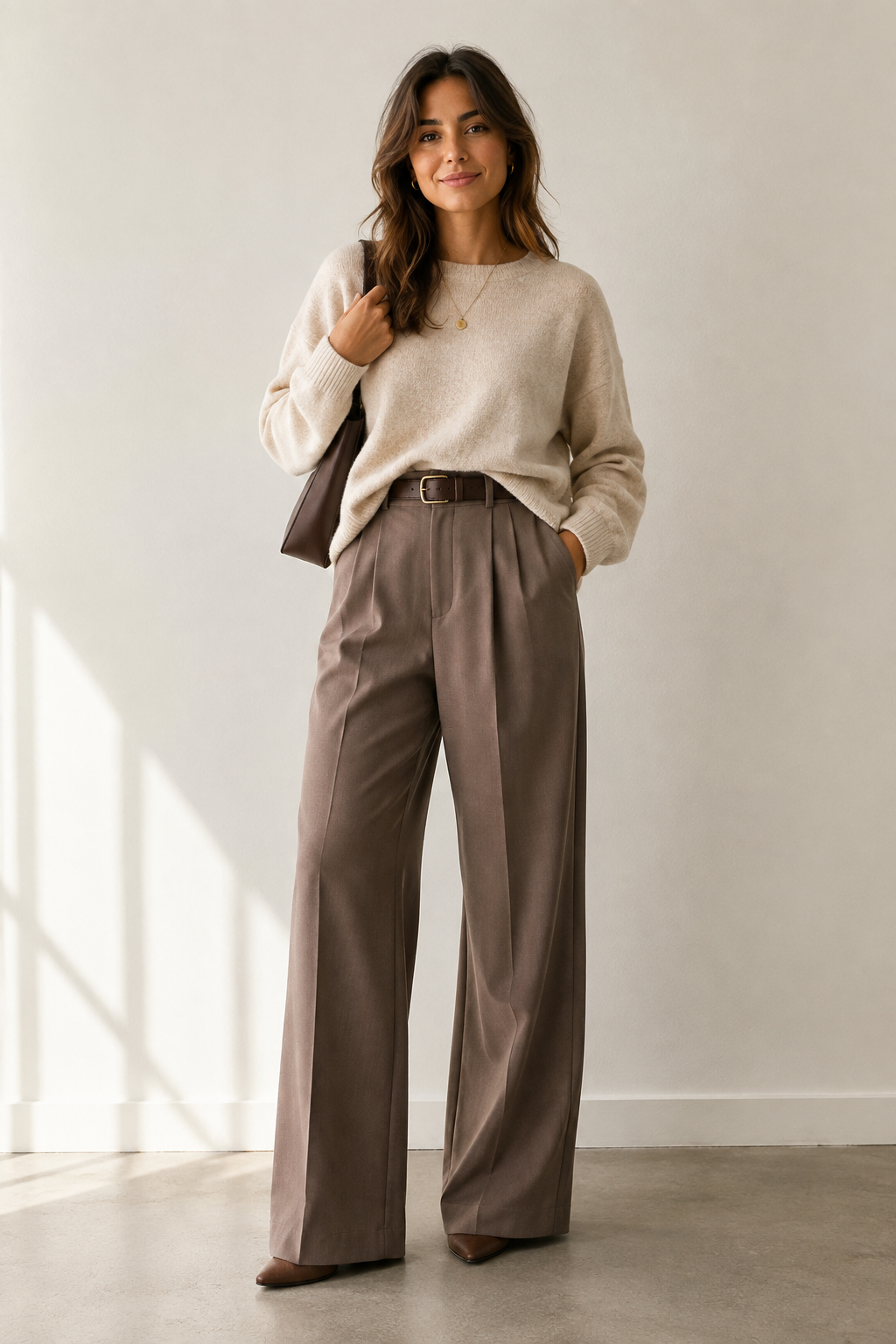
I owned a pair of wide-leg trousers and an oversized sweater, both of which I liked separately, and together they made me look like I'd been swallowed by laundry.
Nothing was wrong with either piece. They fit shoulders right, sleeves right, all the things that decide whether clothes fit properly → Why Your Clothes Fit But Don't Look Right. They just didn't work in the same outfit, and for about a year I assumed that meant one of them was a mistake.
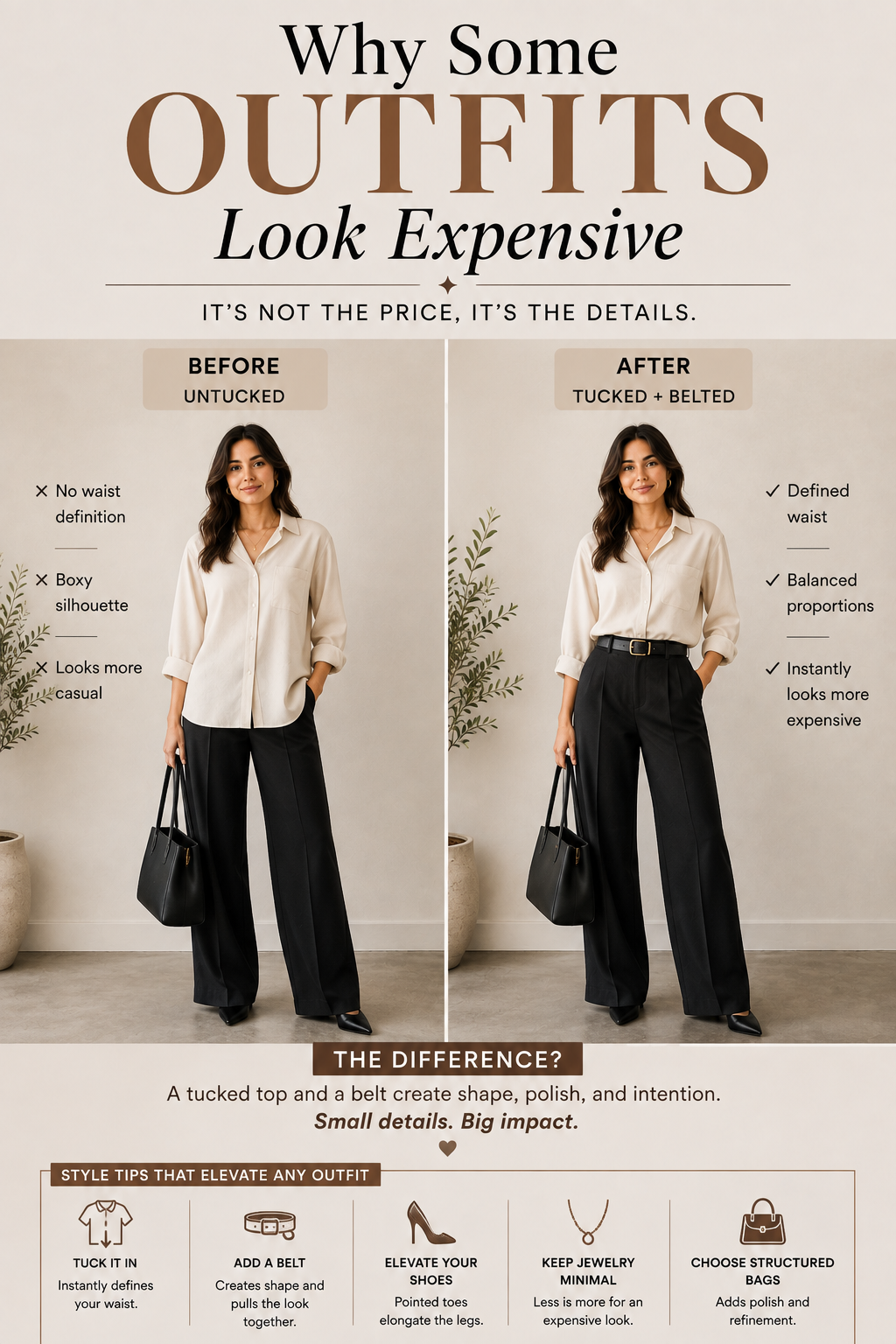
Then I front-tucked the sweater. Same two garments, thirty seconds of adjustment, and the outfit suddenly made sense.
That's proportion. It's a completely different thing from fit, and it's the reason two women can wear near-identical pieces and look like they shop in different price brackets.
Fit vs. proportion
Fit is the relationship between a garment and your body. Does the shoulder seam sit at your shoulder, does the waistband sit where your waist actually is.
Proportion is the relationship between the garments themselves. Where the hems land relative to each other, how volume is distributed, what ratio the outfit divides you into.
You can have perfect fit and terrible proportion. That was my sweater-and-trousers situation two well-fitting garments, badly related.
This is exactly the distinction that trips people up in rooms too. Furniture can be perfectly nice and still sit wrong in a space because the scale relationships are off → Living Room Focal Point: Why Your Room Feels Unfinished. Same failure, different subject.
1. The ratio: avoid halves
The single most useful rule here.
An outfit that divides you into two equal halves at the waist reads as static and shorter. Roughly a one-third / two-thirds split reads as longer and more considered.
How to shift the ratio:
- Tuck. Full tuck, front tuck, or half tuck all move the visual break upward
- Add a belt at the narrowest point of your waist, over a dress or a loose top the single fastest fix on this list
- Crop the top layer. A shorter jacket or cardigan raises the break
- Raise the waistline. Higher-rise trousers or a skirt shift the division up
- Lengthen the bottom. A longer skirt or wide-leg trouser extends the lower third
Which third is bigger depends on you. Longer legs in the lower two-thirds is the common version, but the reverse works too a long tunic or dress over slim leggings puts the break lower and reads as deliberate, not accidental.
A thin waist belt is the cheapest tool here by a wide margin. It works over dresses, coats, oversized shirts and cardigans, and it's the fastest way to test this rule on clothes you already own.
2. Volume balance: one loose, one fitted
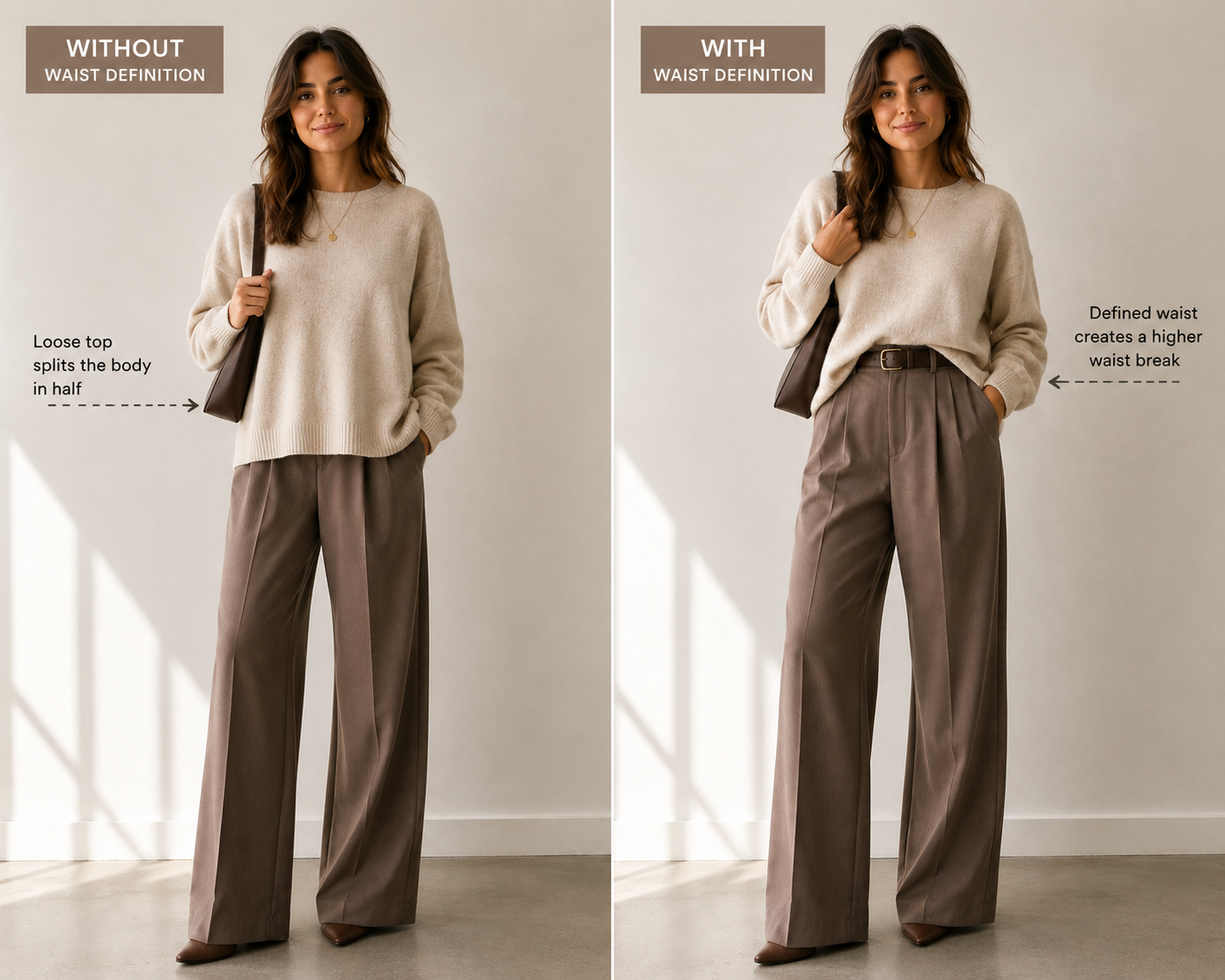
If one half of the outfit has volume, the other half should be closer to the body. That's the entire rule.
- Loose top → slim or straight bottom
- Wide-leg trousers or a full skirt → fitted or tucked top
- Both loose → the laundry problem I had
- Both tight → reads as strained, and it's uncomfortable
The exception, done properly: all-oversized works when there's one point of definition somewhere a belt, a tuck, a rolled sleeve showing a wrist, a heel that anchors the bottom. Volume everywhere with no definition anywhere is what goes wrong.
Weight matters too. Heavy fabric adds visual volume even when the cut is slim. A chunky knit or a structured coat is "loose" for these purposes regardless of how it's cut.
3. Where hems land
Every hem is a horizontal line drawn across your body, and the eye stops at horizontal lines. So the question for each one is: is this a place I want attention?
The principle: hems look best ending at a narrow point of the body, and awkward ending at a wide point.
- Jacket, cardigan and top hems: at the narrowest part of the waist, or below the widest part of the hip. Ending exactly at the widest point of the hip is the least flattering option available.
- Sleeve hems: at the wrist bone, or pushed up to just below the elbow. Mid-forearm is the awkward zone.
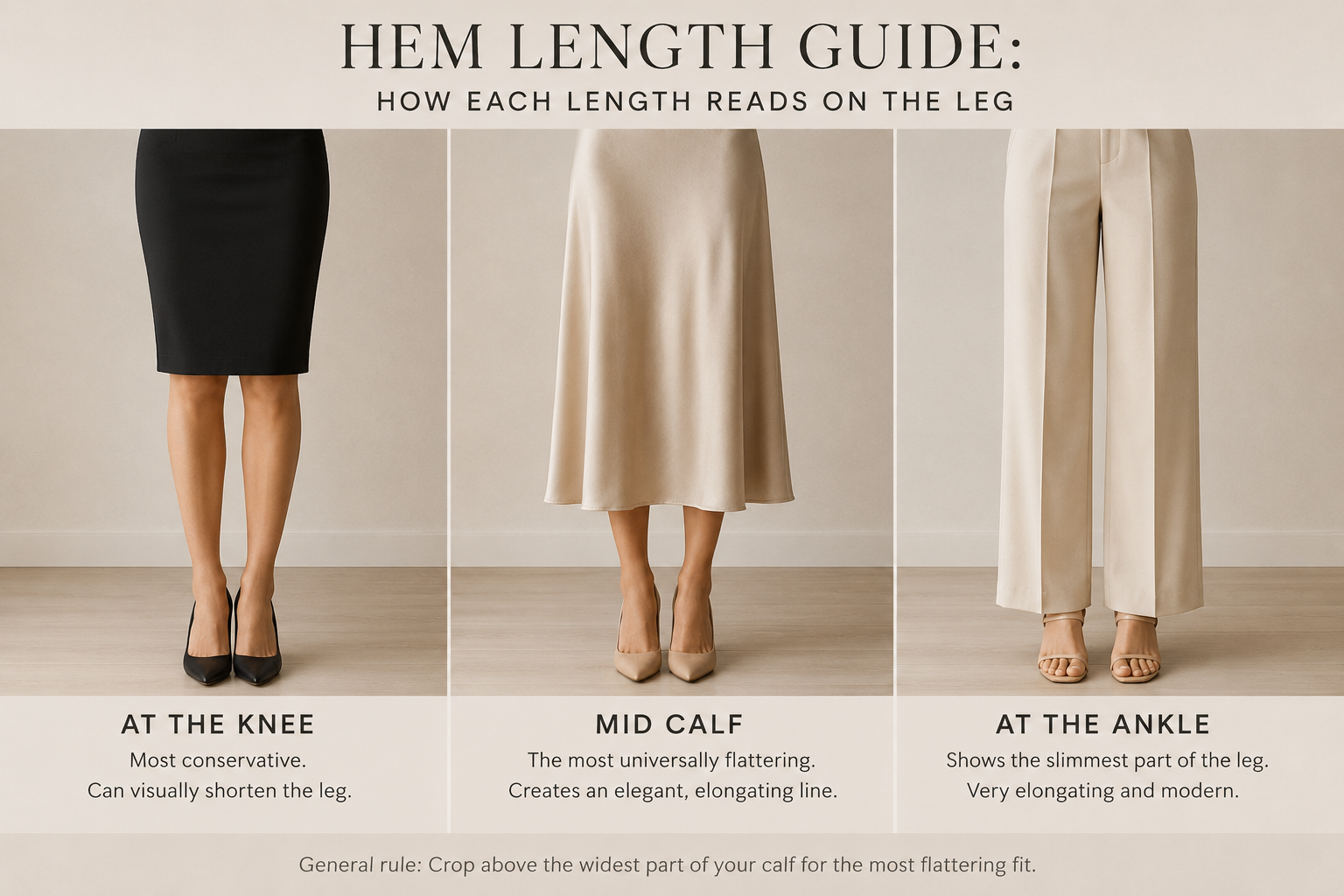
- Trouser hems: at the ankle bone or the top of the shoe. Mid-calf where the calf is widest is the hardest length to wear and the reason a lot of cropped trousers feel wrong.
- Skirt and dress hems: just above or just below the knee, or at mid-calf where the leg narrows. Directly at the widest calf point is difficult, which is why so many mid-length skirts feel like they need the right shoe to work.
This is why cropped anything is tricky. A cropped jacket or cropped trouser is defined by where it stops, so the stopping point has to be chosen rather than accepted. I bought a cropped jacket that ended precisely at my widest point and returned it without ever working out why it bothered me.
4. The unbroken vertical
Anything that creates a continuous vertical line makes the whole outfit read as taller and more expensive.
How to build one:
- Same or similar color top and bottom, or a single-color dress. The most effective version a column of one tone with no horizontal break at all.
- An open long layer over it. A long unbuttoned coat, duster cardigan or blazer creates two vertical lines down the sides.
- Shoes close to the hem color, or close to skin tone a nude or skin-tone heel is the single most reliable trick for this, because it removes the line where the leg ends and the shoe begins.
- Vertical details a center front placket, a long pendant necklace, a pressed crease, a long open cardigan.
What breaks it: a contrasting belt, a bold horizontal stripe, a hem in a strongly contrasting color, or a bag strap cutting diagonally across the body.
None of those are wrong. Just know that each one is a decision to interrupt the line, and make sure you're getting something for it. A pair of nude block heels does more for how tall an outfit reads than almost anything else in a closet.
5. Scale, and matching it to yourself
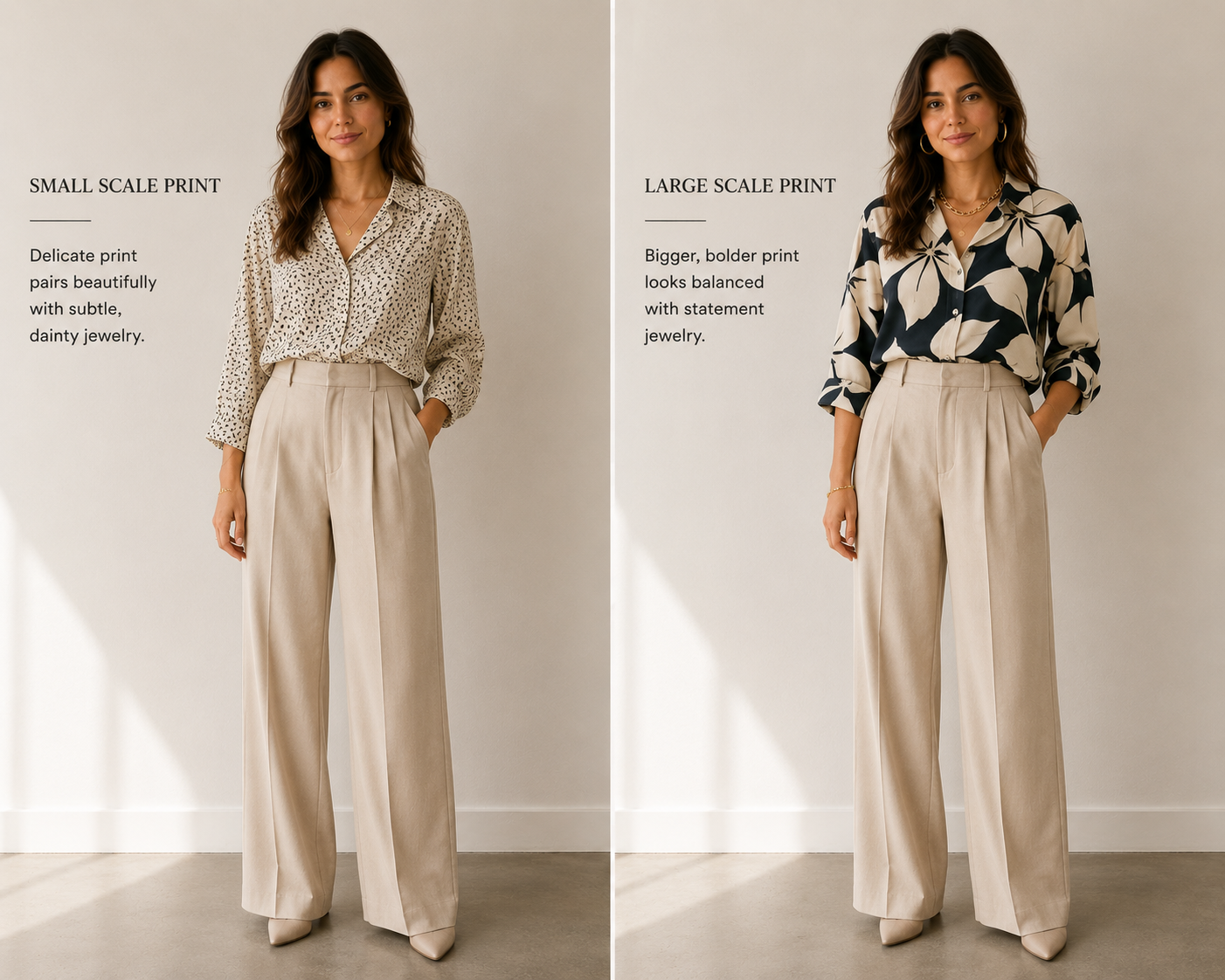
Print size, jewelry size, bag size, collar width these should relate to your overall frame.
Smaller frame: oversized everything can wear you rather than the other way round. Medium-scale prints and proportionate jewelry usually read better than very large statement pieces.
Larger frame: very small prints and delicate jewelry can look undersized. Scale up a bigger earring, a chunkier necklace, a larger bag.
This isn't a rule about what you're allowed to wear. It's about knowing which way the effect runs, so if something feels off you have somewhere to look.
The same principle governs rooms, incidentally art that's too small for the wall it's on → You're Hanging Your Art Too High fails for exactly this reason.
6. Three points of contact
An outfit reads as considered when something appears in at least three places.
A color, a texture, a metal. Rust in the sweater, the sock and the bag. Gold in the earrings, the belt buckle and the watch.
Three is where a viewer's brain stops reading it as coincidence.
This is the exact principle I keep returning to with rooms repetition, not matching, is what makes things look deliberate → Does Furniture Have to Match?. It works for the same reason in both places: the eye is looking for evidence that decisions were made.
A set of gold layered necklaces is a genuinely easy way to build this into an outfit without much thought one piece does the "repeat a metal" job on its own.
The tests
Take a photo. Full length, from a few feet back. A photo flattens you into shapes and blocks, which is exactly what you need proportion problems are almost invisible in a mirror and obvious in a picture.
Squint at it. Half-closing your eyes removes detail and leaves you with the outline and the tonal blocks. If the outline reads as one shape, the proportion works. If it reads as two stacked rectangles of equal size, adjust the ratio.
Ask what's wrong before you change anything. Is it the ratio, the volume, or a hem landing badly? Those have different fixes, and changing the wrong one is how you end up buying replacement clothes for a problem that a belt or a tuck would have solved.
A phone tripod makes this genuinely practical three seconds per outfit instead of asking someone to take a photo. It's the single most useful thing I own for getting dressed.
The short version
Proportion isn't about your body. It's about how the pieces relate to each other, and it's fixable in about thirty seconds most of the time.
- Avoid the halfway split. Tuck or belt something.
- One loose, one fitted.
- Hems at narrow points, not wide ones.
- Build a vertical line, or break it on purpose.
- Repeat one thing three times.
My wide-leg trousers and oversized sweater are still both in rotation. Front-tucked and belted, together, regularly. Nothing was wrong with either of them I just hadn't worked out what they were doing to each other.
Affiliate Disclosure
Some links in this post are affiliate links. If you buy something through one, GlamNestStudio may earn a small commission it doesn't cost you anything extra. I only link to things I'd recommend to a friend, and I've used or genuinely researched everything mentioned here. It's what keeps the guides on this site free.
Before you go
More on the proportions that quietly decide how things read in what you wear and in the rooms you live in across the guides on GlamNestStudio.